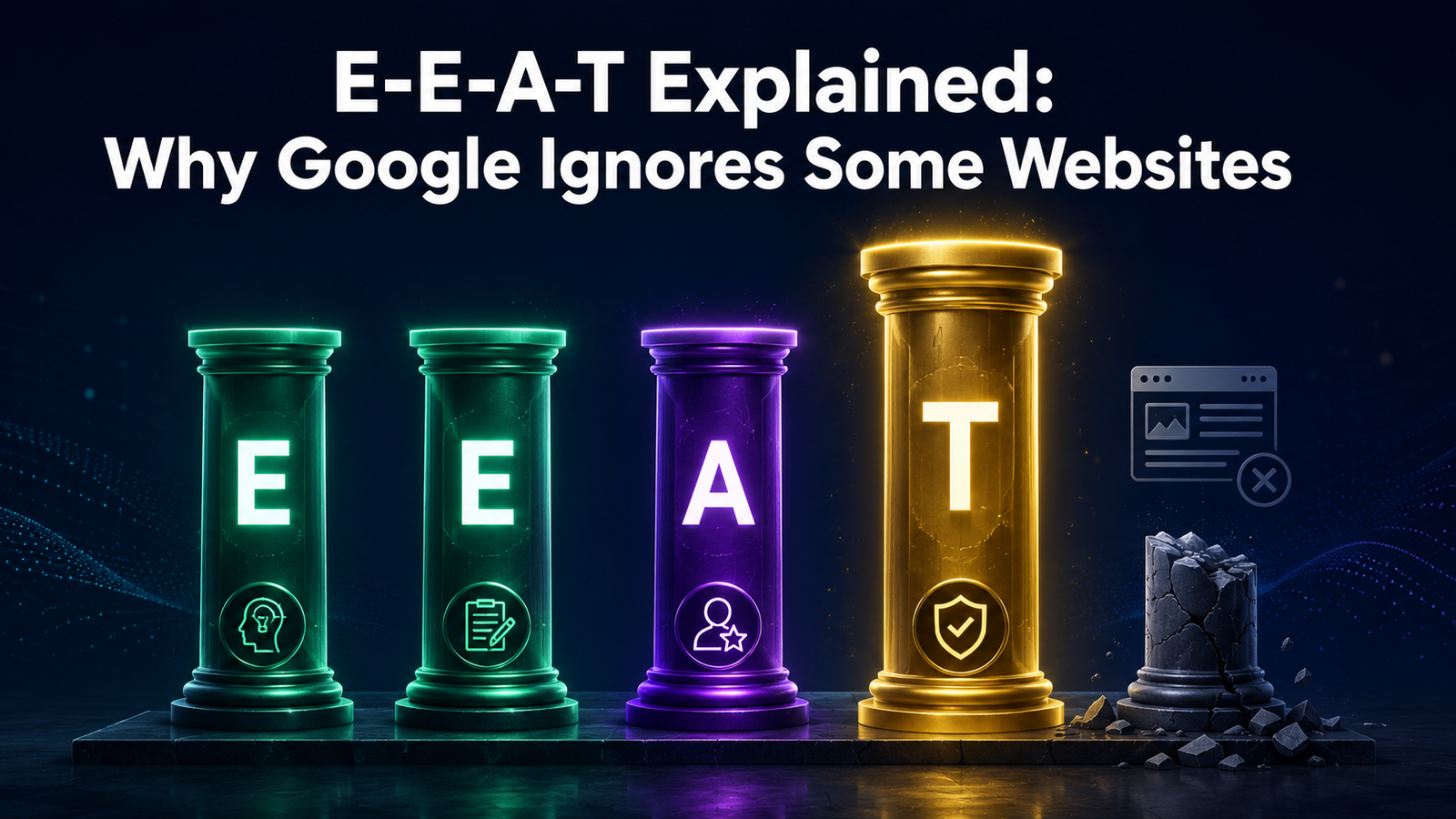
Sites demonstrating strong E-E-A-T signals saw 23% ranking gains after the December 2025 Core Update. Generic content farms with no expertise signals lost significant visibility — some permanently. E-E-A-T is not a box you tick once. It is the ongoing signal Google reads to decide whether your website deserves to rank in the first place — and most websites are missing multiple signals without knowing it.
You have probably seen E-E-A-T mentioned in SEO guides and wondered what it actually means in practical terms. The acronym stands for Experience, Expertise, Authoritativeness, and Trustworthiness — Google's quality framework for evaluating whether a website and its content genuinely deserve to rank. But here is the thing most explanations get wrong: E-E-A-T is not a checklist or a single algorithm signal. It is a quality evaluation framework that Google uses to train its ranking systems and to instruct its human quality raters — and understanding it at that level changes exactly how you should approach your content strategy.
This guide explains what each component of E-E-A-T means in plain language, the most common mistakes that cause websites to score poorly, and the specific, actionable changes that move the needle. No jargon, no vague advice — just what actually works in 2026.
What E-E-A-T Actually Is — And What It Is Not
E-E-A-T is not a direct ranking factor. There is no "E-E-A-T score" in Google's algorithm. E-E-A-T is a quality framework — a set of principles that Google uses to train its ranking algorithms and instruct its human quality raters. Think of E-E-A-T as the blueprint Google's algorithm is built to approximate.
E-E-A-T is evaluated at both page and entity level. It applies to individual pages and to entire websites. A single well-sourced, author-attributed article on an otherwise thin site will not achieve strong E-E-A-T — the signals need to be consistent across the whole site.
"In 2026, E-E-A-T is not a guideline — it is a gatekeeper. Content without visible experience, ownership, and trust signals will increasingly struggle to compete, no matter how well it is optimised."
— BKND Development, E-E-A-T in 2026: The Content Quality Signals That Actually MatterThe Four Components — What Each One Actually Means
Experience
Added 2022The question Google asks: Did the creator actually do, use, or live through the thing they are writing about?
Experience is the newest addition to the framework, added in December 2022 specifically to reward first-hand knowledge over aggregated research. A product review written by someone who purchased and used the product demonstrates experience. A review written by synthesising other reviews does not — even if it covers all the same points.
This component was added as a direct response to the proliferation of content farms that produce technically accurate but hollow content. Google wanted to reward actual human experience over competent summarisation.
Expertise
Original E-A-TThe question Google asks: Does the creator have the depth of knowledge to write accurately and helpfully on this topic?
Expertise is demonstrated, not claimed. Content that correctly uses technical terminology, explains nuanced concepts accurately, addresses edge cases that only someone deep in the subject would know, and provides guidance beyond surface-level advice — that demonstrates expertise.
The practical test: if you stripped away all claims of expertise from your content, would a knowledgeable reader still be able to tell that the author knows this subject deeply?
Authoritativeness
Original E-A-TThe question Google asks: Do other authoritative sources in this space recognise and reference this site or creator?
Authority is external validation — it comes from other people and sites, not from what you say about yourself. Backlinks, brand mentions in industry publications, citations in other articles, being quoted as a source — these all build the entity-level authority that Google increasingly measures.
Authority is also topical and niche-specific. A specialist SEO blog with a smaller audience but deep topical consistency can have higher authority for SEO-related queries than a major general tech publication.
Trustworthiness
Most ImportantThe question Google asks: Can users and Google confidently rely on this page to be accurate, honest, and safe?
Trust is the foundation of the entire framework. Google's own Quality Rater Guidelines are explicit: "Trust is the most important member of the E-E-A-T family because untrustworthy pages have low E-E-A-T no matter how Experienced, Expert, or Authoritative they may seem."
Trust signals include: HTTPS security, clear ownership and contact information, accurate factual content, transparent editorial standards, and a clean security record.
The Secret Google Doesn't Advertise — The Quality Tier System
One of the most significant reveals from the 2024 Google API documentation leak was confirmation that Google's quality evaluation happens even before ranking — at the indexing stage. A system called SegIndexer assigns every document to a quality-based tier during indexing. A document's tier position can effectively disqualify low-quality content from competing in rankings before the ranking algorithm even evaluates it.
This is the mechanism behind what many site owners experience as "my page is indexed but gets zero impressions." The page was not penalised — it was tiered into the Landfill or Zeppelin category during indexing. Improving E-E-A-T signals is not just about ranking better — it is about moving from a lower tier to the Base tier where you can actually compete.
The 7 Biggest E-E-A-T Mistakes That Get Websites Ignored
How to Fix It — One Action Per E-E-A-T Signal
Include at least one specific, first-hand observation in every content piece you publish. Not general advice — something specific that only comes from actually doing the thing. This could be a test result, a specific problem you encountered, a screenshot of your own data, or a comparison from your own usage.
Keyword density of 1–2% is generally considered optimal for SEO. Going above 3% can be seen as keyword stuffing by Google.
When we ran the Keyword Density Checker on our own top-ranking pages, the sweet spot was consistently 1.1–1.6%. Pages that crossed 2.5% on short-form content under 800 words actually ranked lower than equivalent pages we had thinned out.
The second version demonstrates experience because it contains a specific observation from real usage that only someone who actually tested this would know.
Every article should be attributed to a named individual with a visible author bio that includes relevant credentials, professional background, and a link to their LinkedIn or professional profile.
- Author name visible on every article — not just in the metadata
- Author bio that explains relevant expertise specifically, not generically
- Link to author's LinkedIn, published portfolio, or professional profile
- Author schema (JSON-LD) so Google can read credentials in structured form
- An author archive page showing all their published articles
Authoritativeness in your niche is built by covering that niche comprehensively and consistently. Content clusters — a pillar page on a broad topic supported by multiple in-depth articles on specific sub-topics, all interlinked — build the topical coverage that Google reads as domain-level expertise.
Identify the 5–10 most important sub-topics within your niche. Create at least 3–5 well-researched articles on each sub-topic. Interlink them with contextual, descriptive anchor text. Check your current backlink profile with the Backlink Checker to identify your strongest pages and spread authority via internal linking.
- HTTPS active with valid SSL certificate — Verify with the Website Reviewer. An expired SSL is a disqualifying trust failure.
- Clear ownership and contact information — Named owner or editorial team, physical or email contact, and a real About page.
- Privacy Policy and Terms of Service pages — Required for trust and increasingly required by regulation.
- No blacklist or malware flags — Check with the Google Malware Checker and Blacklist Checker.
- Accurate, up-to-date content with visible dates — Add "Last updated: [Month Year]" to every key article and actually update the content when you update the date.
YMYL Content: Your Money or Your Life
Google applies stricter E-E-A-T standards to any content that could significantly affect a person's health, financial stability, safety, or wellbeing — called YMYL (Your Money or Your Life). This includes health and medical advice, financial and legal guidance, safety information, and news.
If your site covers YMYL topics, specific requirements apply:
- Author credentials must be relevant to the specific topic
- Content must be reviewed and approved by qualified professionals — with the reviewer credited visibly
- Sources must be cited to authoritative primary sources
- Content must be reviewed and updated at least quarterly
- Conflicts of interest must be disclosed transparently
E-E-A-T and AI-Generated Content
Google's official position, confirmed by multiple statements from Search Liaison Danny Sullivan: Google evaluates content quality regardless of how it was produced. AI-generated content that demonstrates genuine expertise, contains accurate and helpful information, and is produced or reviewed by someone with real knowledge can have strong E-E-A-T.
Using AI to help write or research content is not the E-E-A-T problem. Publishing AI content without adding first-hand Experience and expert Expertise review is the problem. A human expert's review, the addition of first-hand observations, and accurate attribution of expertise are what make AI-assisted content competitive in the E-E-A-T framework.
Read any article on your site and ask: if a knowledgeable person in this field read this, would they be able to tell that the author has genuine first-hand experience? Would they find insights here that are not in the top five Google results for the same query? Would they be confident recommending this page as a reliable source? If the honest answer is no to any of these, you have identified your E-E-A-T gap — and a specific content improvement to make.
Your E-E-A-T Improvement Checklist
- Add named author with credential-specific bio to every published article
- Create author schema (JSON-LD) linking author to their professional profile
- Add a visible "Last Updated" date to every key content page
- Update any statistics or recommendations older than 12 months in your top 10 pages
- Create or improve your About page — name the team, explain credentials and editorial standards
- Add clear contact information (email, form, or physical address)
- Ensure HTTPS is active and SSL certificate is valid — check with the Website Reviewer
- Check for malware and blacklist flags using the Google Malware Checker and Blacklist Checker
- Confirm all key pages are indexed via the Google Index Checker
- Add at least one specific, first-hand observation to your top 5 most important articles
- Check meta tags and descriptions on key pages with the Meta Tags Analyzer
- Check your backlink profile with the Backlink Checker — identify pages with strong external authority and spread that authority via internal links
- Create or improve Privacy Policy and Terms of Service pages
- Plan a content cluster: identify your core topic area and map at least 3–5 supporting articles per sub-topic
- If you cover YMYL topics, confirm all content is reviewed by a qualified professional and that reviewer is credited visibly
Check the Technical Trust Signals First
Trust is the E-E-A-T foundation. Fix these technical signals before improving content.