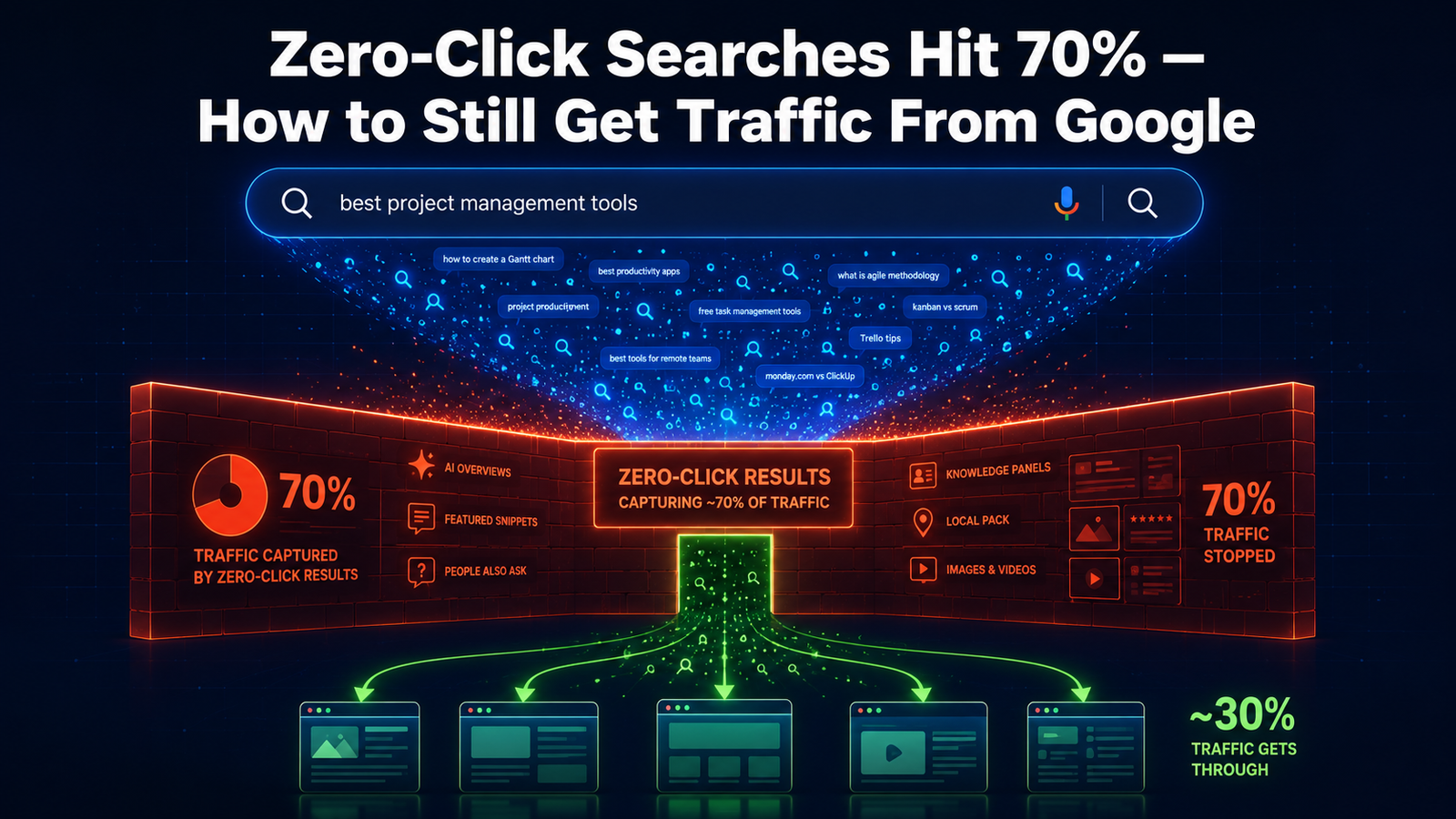
For every 1,000 Google searches in the US, only 360 result in a click to an actual website. The other 640 end on Google's own results page — answered by an AI Overview, a featured snippet, a knowledge panel, or simply abandoned. Zero-click search rose from 56% to 69% in a single year. In Google's new AI Mode, the zero-click rate hits 93%. This is not a temporary anomaly. It is the new structure of search — and there are specific, proven ways to keep winning traffic inside it.
If your organic traffic has been declining despite stable rankings, you are not doing anything wrong — the search landscape itself has fundamentally changed. The clicks that used to flow from Google's results pages to websites are increasingly staying on Google. Understanding exactly where those clicks went, which types of content still earn them, and how to adapt your strategy is now the difference between sites that survive this shift and sites that quietly fade.
This article covers the real numbers behind zero-click search, the types of queries where clicks still happen, and seven specific strategies for capturing traffic — and value — in a search environment where the majority of searches never leave Google.
Where 1,000 Google Searches Actually Go
The trend has been building for over a decade — Google introduced Knowledge Panels in 2012 and Featured Snippets in 2014, each absorbing a share of clicks that previously went to websites. Rand Fishkin of SparkToro first rigorously quantified zero-click search at around 50% in 2019. What changed in 2024–2026 is the acceleration: AI Overviews now trigger on nearly half of all queries, and when one appears, 83% of those queries end without any click at all.
"In a zero-click world, traffic is a terrible goal. Every platform — Google, Facebook, LinkedIn, Reddit, YouTube and the AI tools — will send less traffic in 2026 than in 2025."
— Rand Fishkin, Founder of SparkToroWhich Queries Still Produce Clicks — And Which Don't
Zero-click is not evenly distributed. Some query types have lost most of their clicks; others have barely changed. Knowing the difference is the foundation of a zero-click-era content strategy — because it tells you exactly where to invest your content effort.
| Query Type | Click Survival | Why |
|---|---|---|
| Simple definitions ("what is X") | Mostly gone | Fully answered by AI Overviews and featured snippets — no reason to click |
| Quick facts (dates, conversions, weather) | Mostly gone | Knowledge panels and instant answers absorbed these years ago |
| Basic how-to (short answers) | Heavily reduced | 3-4 step answers fit entirely inside an AI Overview |
| Complex how-to (multi-step, visual) | Partially surviving | Detailed processes still require the full page — AI summaries feel insufficient |
| Comparisons and reviews | Partially surviving | Users want depth and trust signals AI summaries cannot fully provide |
| Tools and calculators | Strong survival | Interactive functionality requires visiting the actual tool — AI cannot replace it |
| Transactional ("buy", "download", "free X") | Strong survival | User intent requires a destination — only 5-8% of these trigger AI Overviews |
| Branded searches (your name) | Strongest survival | 3× higher CTR than generic queries — users specifically want YOUR site |
| Local intent ("near me") | Strong survival | Maps and local results drive real-world visits — clicks and calls survive |
The pattern is unmistakable: content that informs is losing clicks; content that does something is keeping them. Informational content traffic is down 23% over three years while product page traffic declined only 4%. Tools, calculators, interactive resources, transactional pages, and branded destinations are structurally protected because an AI summary cannot substitute for them — the user needs the actual page to accomplish their goal.
7 Strategies to Win Traffic in the Zero-Click Era
The most direct response to the data: build more of what still earns clicks. Free tools, calculators, templates, interactive checkers, and downloadable resources are structurally immune to zero-click absorption — an AI Overview can describe a keyword density checker but cannot be one. Users who need the function must click through.
This is why tool-based websites have weathered the zero-click shift far better than pure content blogs. If your site is currently 100% articles, adding even two or three genuinely useful free tools changes your traffic resilience profile fundamentally. The tools also earn backlinks naturally — resource pages and listicles link to functional tools far more readily than to articles.
Transactional and commercial-intent queries trigger AI Overviews only 5–8% of the time, compared to 36%+ for informational queries. Google has a structural incentive to preserve clicks on commercial queries — that is where its ad revenue lives. For content strategy, this means keywords with modifiers like "best", "free", "download", "tool", "vs", "pricing", and "alternatives" retain dramatically more click-through than definition and explainer queries.
Audit your keyword targets and classify them by intent. For every high-risk informational keyword in your plan, ask whether there is a commercial-intent variant serving the same audience: "what is page authority" (high zero-click risk) versus "free page authority checker" (click-protected, tool intent). Same audience, completely different click survival.
Branded searches have 3× higher CTR than generic queries, and branded queries with AI Overviews actually show CTR increases. When someone searches your brand name, no AI summary satisfies them — they want your site specifically. This makes brand recognition the single most durable traffic asset in the zero-click era.
Brand building for a small site is not advertising budgets — it is consistent visibility: being the recognisable name in your niche's Reddit and forum discussions, publishing original data others cite, having a memorable site name people recall and search directly. Bain & Company's recommended metric for this: track your brand search volume in Google Search Console. If branded impressions grow while generic organic declines, your strategy is working — people know you and search for you by name, and no AI can intermediate that.
When you cannot win the click, win the mention. Brands cited inside AI Overviews earn 35% more organic clicks and 91% more paid clicks than non-cited brands on the same query. Even the zero-click impression has value: the user reads an answer with your brand attached, building the recognition that later becomes a branded search.
The citation optimisation playbook: structure every section to open with a direct, self-contained answer (40–167 words), add specific statistics with named sources, use question-format headings, implement FAQ schema, and keep content updated quarterly. Verify your pages are indexed with the Google Index Checker — uncited starts with unindexed.
AI Overviews synthesise existing consensus information. They cannot replicate: original research and first-party data, genuine first-hand experience and testing, strong opinions with reasoning, detailed visual walkthroughs, and current/breaking developments. Content built on these elements gives searchers a reason to click even when a summary is present — because the summary visibly cannot contain what the page offers.
The practical test for every planned article: "Could an AI summarise this completely in four sentences?" If yes, the click is at risk — either add irreplaceable elements (your own data, your own tests, your own images) or shift the topic toward a click-protected format.
Here is the silver lining buried in the data: clicks that survive AI Overviews convert 23% better than pre-AIO traffic. Users who read an AI summary and still click are deeper in their journey — they wanted more than the summary offered. Fewer visitors, but more valuable ones.
This changes on-page priorities. The surviving visitor has already consumed the basics from the AI summary — do not make them re-read a 400-word introduction covering what they already know. Lead with the depth, the data, the tool, or the unique value they clicked for. Fast pages matter more than ever for these high-intent visits: check yours with the PageSpeed Insights Checker — losing a high-intent visitor to a slow load is now twice as costly.
Measuring success purely by organic sessions in a zero-click world guarantees the appearance of failure even when your actual market visibility is growing. The metric framework recommended by Bain & Company for the zero-click era:
- Organic sessions / clicks
- Click-through rate
- Traffic growth month-over-month
- Rankings alone
- Search impressions (GSC) — visibility even without clicks
- Branded search volume — the awareness signal AI cannot intercept
- AI citation share — how often AI answers mention you vs competitors
- Conversion rate of surviving traffic — quality over quantity
Track impressions in Google Search Console alongside clicks. Stable-or-growing impressions with declining CTR means you are visible but being zero-clicked — a citation optimisation problem. Declining impressions means a genuine visibility problem — a ranking and indexing issue to diagnose first.
What Not to Do
Do not abandon informational content entirely. It still builds the topical authority that makes your commercial pages rank, earns the backlinks that strengthen your whole domain, and creates the citation surface for AI answers. The adjustment is rebalancing the portfolio — more tools and commercial content, smarter informational content — not deleting half your site.
Do not block AI crawlers in retaliation. Blocking retrieval bots removes you from AI citations entirely while the zero-click trend continues regardless. You lose the mention value and gain nothing.
Do not chase pre-2024 traffic baselines. Gartner forecasts traditional search volume dropping 25% by 2026. Comparing this year's traffic to 2023's and concluding your SEO is failing misreads a structural market shift as a performance problem.
Your Zero-Click Survival Checklist
- Classify your top 20 target keywords by click survival: informational (high risk) vs tool/commercial/branded (protected)
- Plan at least one free tool, calculator, or interactive resource for your niche this quarter
- Find tool-intent and commercial-intent keyword variants with the Keyword Suggestion Tool
- Restructure top informational pages to open every section with a direct, citable answer
- Confirm all key pages are indexed via the Google Index Checker
- Check meta titles and descriptions with the Meta Tags Analyzer — compelling snippets win a larger share of the clicks that remain
- Verify page speed with the PageSpeed Insights Checker — high-intent surviving traffic must not be lost to slow loads
- Set up impression tracking in Google Search Console alongside click tracking
- Start monitoring your branded search volume monthly — your most important new KPI
- Add one element AI cannot summarise (original data, testing, tooling) to every major content piece
Build Your Click-Protected Foundation
Check the signals that still drive traffic in the zero-click era — all free, no sign-up.